
Disclaimer: This post contains affiliate links. If you make a purchase through these links, I may earn a small commission at no additional cost to you. I only recommend products I genuinely test and believe in.
At-home radiofrequency devices can support firmer, smoother and more lifted-looking skin, but the best device is not necessarily the one with the highest wattage, the most electrodes or the longest list of features.
It is the one that can be used consistently enough to produce a cumulative result.
That is where the MimiSilk Vera RF Sculpt takes a different approach. Unlike many traditional home radiofrequency devices, Vera does not require conductive gel or continuous gliding movements. Instead, it uses a stationary stamping technique designed to deliver controlled heat into the dermis in short treatment sessions.
The result is a simpler, more targeted radiofrequency routine that takes approximately ten minutes.
What does the MimiSilk Vera RF Sculpt do?
The MimiSilk Vera RF Sculpt is an at-home radiofrequency device designed to improve the appearance of:
- Mild skin laxity
- Fine lines and wrinkles
- Crepey skin
- Nasolabial folds
- Lower-face softness
- Jawline definition
- Neck ageing
Radiofrequency works by creating controlled thermal energy within tissue. As the skin resists the electrical energy, heat is generated. This can cause existing collagen fibres to contract temporarily while also stimulating longer-term remodelling processes involving collagen and elastin.
A peer-reviewed review of radiofrequency facial rejuvenation explains that RF treatments can produce immediate collagen contraction followed by longer-term changes in the dermis.
This does not mean an at-home RF device produces the same result as a facelift or professional Thermage treatment. The realistic goal is gradual improvement in firmness, texture and the overall quality of the skin.
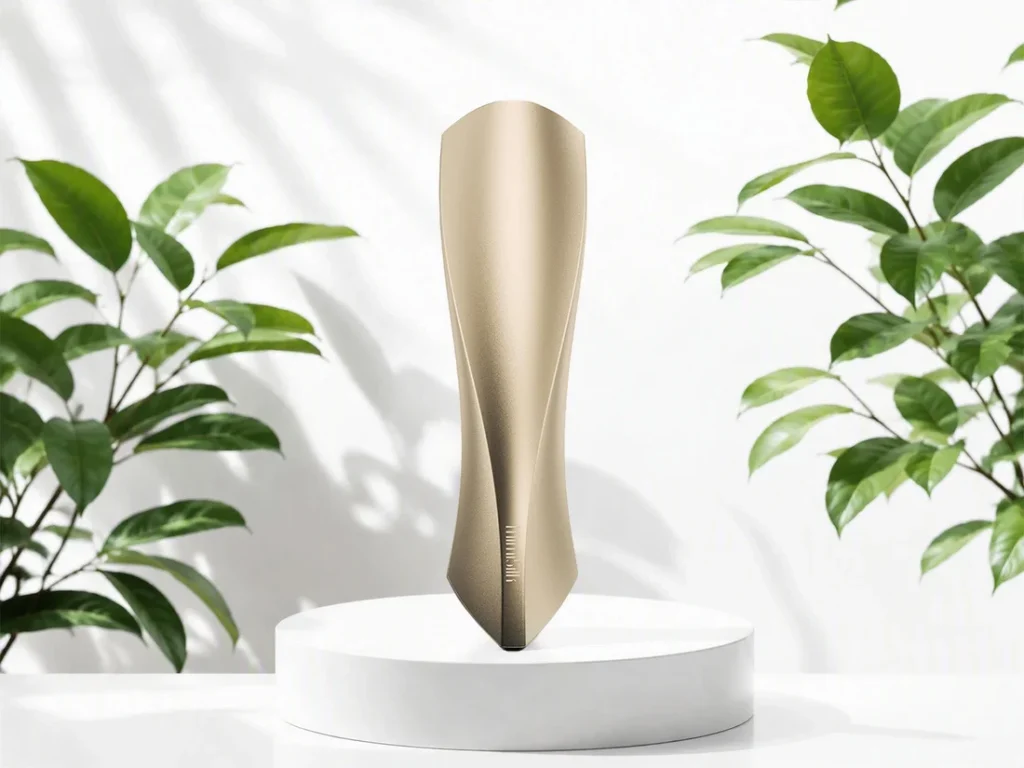
How is MimiSilk Vera different?
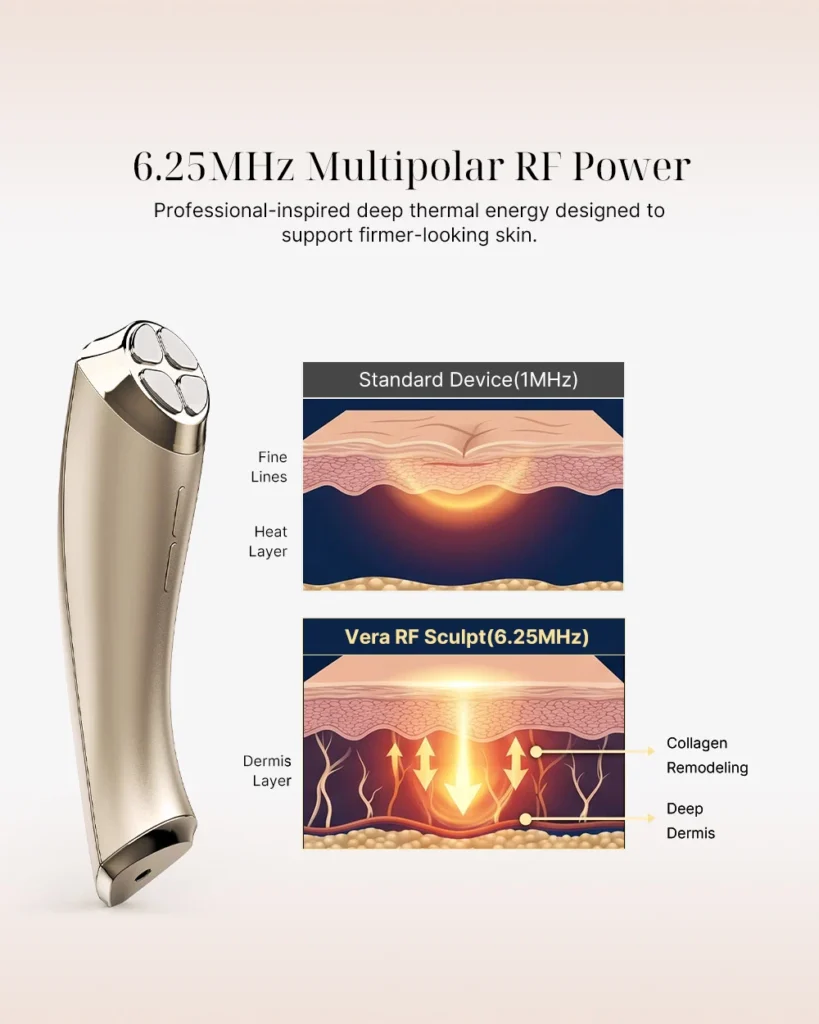
Vera operates at 6.25MHz using what MimiSilk describes as multipolar displacement-current technology. The company states that the device is designed to target approximately 2.5 to 3 millimetres beneath the skin.
Those figures are manufacturer specifications rather than independently verified measurements, but they are useful when understanding how Vera is intended to work.
The device is also gel-free. Instead of applying a thick conductive medium and moving the device repeatedly across the skin, Vera is placed flat against the treatment area and held stationary for several seconds before being lifted and repositioned.
This is particularly useful around the jawline, lower cheeks, mouth area and forehead, where controlled placement can be easier than maintaining continuous movement.
The official product information states that Vera has three intensity levels, a maximum output of up to 18 watts and a weight of approximately 178 grams. It is a plug-in device rather than a wireless model, which MimiSilk says allows for more stable energy delivery.
Does 6.25MHz mean Vera reaches deeper than other RF devices?
Not necessarily.
Frequency is only one part of radiofrequency technology. Treatment depth and heating pattern are also influenced by electrode configuration, spacing, power, treatment duration, tissue resistance, contact quality and whether the device is monopolar, bipolar, multipolar or fractional.
This is why comparing devices purely by megahertz can be misleading.
For example, the Medicube Ultra Tune operates at 40.68MHz, but that does not mean it automatically reaches more than six times deeper than Vera. Medicube describes Ultra Tune as a combination of RF and microcurrent designed for daily use, but it does not publish the same clear millimetre treatment depth as Vera. You can view the official Medicube Ultra Tune specifications here.
The facial dermis also varies considerably depending on the area of the face and the individual. A stated depth of 2.5 to 3 millimetres may sit within the deeper dermis in one area while approaching the boundary beneath the dermis in another.
Deeper is not automatically better. For collagen support, controlled and even heating within the dermis matters more than simply pursuing the greatest possible depth.
Is MimiSilk Vera the same as Thermage?
No.
Thermage is a professional monopolar radiofrequency system used under clinical supervision. It incorporates treatment tips, cooling, calibration and energy delivery controls that are not present in the same way on a small home-use device.
The shared principle is controlled RF heating, but the power, delivery system, treatment environment and level of professional oversight are very different. The official Thermage explanation of its technology describes the importance of controlled heating and epidermal cooling during professional treatments.
Vera should therefore be viewed as a home-maintenance device inspired by the same broad technology, not as a portable Thermage replacement.
That is a positive distinction. Professional RF treatments are performed less frequently at considerably higher intensity. Vera is designed for repeatable, lower-intensity use at home.
MimiSilk Vera compared with other popular RF devices
| Device | Main approach | Best suited to |
|---|---|---|
| MimiSilk Vera | 6.25MHz gel-free stamping RF with a stated 2.5 to 3mm target | Focused firmness, laxity and lower-face support |
| AMIRO R3 Turbo | RF combined with microcurrent, infrared and LED | Buyers wanting several technologies in one device |
| Medicube Ultra Tune | 40.68MHz RF combined with microcurrent | Gentle, frequent hybrid treatments |
| NEWA Classic | Gel-based 3DEEP RF with a structured clinical routine | Buyers prioritising regulatory history and published evidence |
| Nebulyft R1 | Multipolar micro-RF with 256 gold dots | Broad coverage and wireless use |
| CurrentBody Skin RF | Temperature-controlled bipolar RF | Buyers comfortable with long weekly treatments |
| VEAUTY Dot | Fractional RF using 144 platinum electrodes | Surface texture and more concentrated micro-zones |
NEWA is particularly notable because the classic wired version has an FDA De Novo classification, and a 12-week PubMed-indexed study reported improvements in wrinkles, firmness, elasticity and measured collagen-related outcomes.
That does not make other devices ineffective. It simply means NEWA has a different level of published product-specific evidence.
The AMIRO R3 Turbo is more versatile, offering RF alongside other technologies. The Nebulyft range focuses on multipolar micro-electrode coverage, while the VEAUTY Dot uses fractional RF and 144 electrodes.
The CurrentBody Skin RF device follows a much longer protocol, with gel application and approximately five minutes per treatment area. It may suit someone who prefers one weekly session, but Vera is considerably easier to fit into a busy routine.
Is MimiSilk Vera worth buying?
100%… and I don’t say that lightly!
The main reason to choose Vera is convenience.
It delivers a focused RF treatment in around ten minutes, without conductive gel, lengthy gliding movements or a complicated routine. That makes it particularly appealing for mature skin, mild laxity, crepey texture and anyone wanting to concentrate on the jawline and lower face.
The device is currently listed at approximately $699 on MimiSilk’s US product page, although regional pricing and promotions can change. The same page lists a two-year warranty and 90-day money-back guarantee, so buyers should check the terms applying to their country before ordering.
Vera will not create a surgical lift, remove significant excess skin or replace professional treatment. Its strength is providing controlled, repeatable home radiofrequency that is easy enough to use consistently.
For anyone who has abandoned gel-based RF devices because they take too long, feel messy or end up forgotten in a drawer, the MimiSilk Vera RF Sculpt is one of the more thoughtfully designed alternatives currently available.