
Can a 3-minute LED eye mask make a visible difference to crow’s feet, crepey under-eye skin and dark circles? I’ve been using the AMIRO Spectra LED Eye Mask for 8 weeks, and this is one of those devices that makes sense to me precisely because it isn’t trying to treat every square inch of my face. It’s focused on an area that, at 45, has become increasingly difficult to keep looking as refreshed as I’d like.
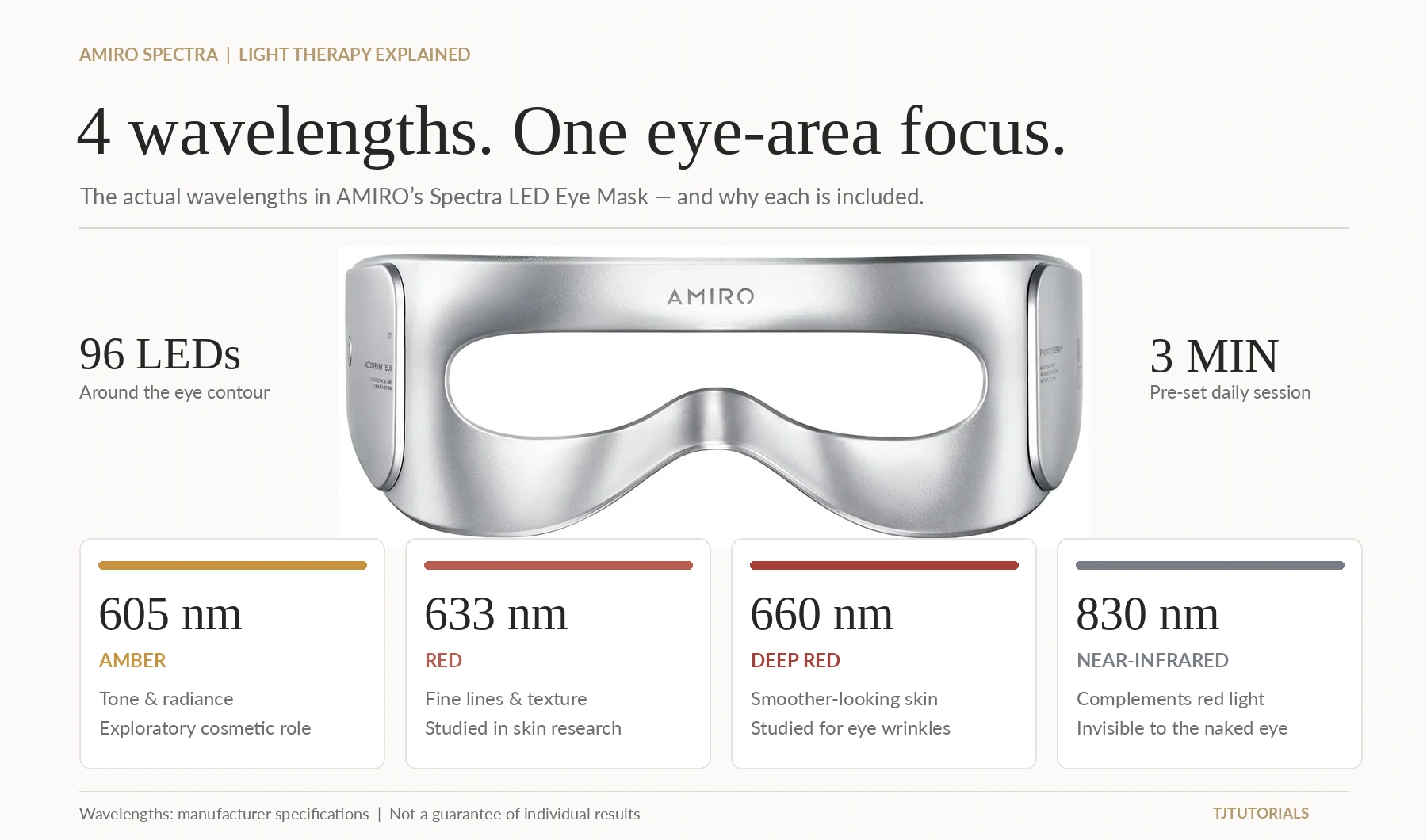
The Spectra combines 4 wavelengths — 605 nm, 633 nm, 660 nm and 830 nm — with 96 LEDs in a pre-set, 3-minute treatment. But a wavelength list isn’t a result, and a shiny silver device isn’t a substitute for evidence. Here’s what the technology can realistically offer, what published research tells us, how to use it correctly, and what I’ve personally noticed.
My verdict after 8 weeks: It’s an appealing dedicated red light therapy eye mask for somebody whose main concerns are the appearance of fine lines, crow’s feet and crepey texture around the eyes. I’ve seen modest but welcome improvements in how smooth and supported my own under-eye area looks. I used it alongside the AMIRO Optical Prism Eye Cream, though, so I can’t attribute those changes to the LED mask alone.
It’s not a solution for every dark circle, and I wouldn’t tell anybody who already has good coverage from a full-face LED mask that they automatically need another device. That would be excellent marketing. It wouldn’t necessarily be excellent advice.
The AMIRO Spectra LED Eye Mask is a wearable, rechargeable LED device designed specifically for the skin around the eyes rather than the whole face. It has eye openings, an adjustable strap arrangement, a soft silicone contact area and an automatic end to its programmed treatment.
According to AMIRO’s published specifications, its key features are:
| Specification | AMIRO Spectra |
|---|---|
| Technology | LED light therapy / photobiomodulation |
| Wavelengths | 605 nm amber, 633 nm red, 660 nm deep red, 830 nm near-infrared |
| Number of LEDs | 96 |
| Reported irradiance | 65 mW/cm² |
| Programmed session | 3 minutes |
| Calculated nominal dose for 3 minutes | 11.7 J/cm², assuming constant 65 mW/cm² output |
| Weight | Approximately 119.5 g |
| Charging | USB-C |
| Manufacturer’s suggested frequency | Daily, following the supplied instructions |
I like a brand that publishes wavelengths and irradiance instead of just describing a mask as powerful. Powerful tells me very little. A figure gives us something to examine — even if manufacturer-reported performance should not be confused with independent testing.
There’s a reason I keep coming back to this part of the face in my skincare routine. The skin around the eyes is relatively delicate, it’s constantly involved in facial expression, and the tissues beneath it change as we age. Smile, laugh, squint, or look at another influencer insisting their latest eye cream has replaced filler — it all shows up around here eventually.
But not every under-eye concern has the same cause. A peer-reviewed review of periorbital discolouration describes several categories of dark circles, including pigmentation, visible vascular colouring and structural shadowing.
This distinction is useful before buying anything:
That last one may be inconvenient for marketing departments, but it’s important for our expectations.
The Spectra uses 4 wavelengths, not 4 interchangeable colours. Each is selected for a different role within the device’s light-therapy approach.
AMIRO positions 605 nm amber as a wavelength to complement the appearance of even skin tone and radiance. Amber-light research is developing, but it’s important not to pretend that every amber study used the Spectra’s exact 605 nm setting.
For example, a 2023 randomised split-face study involving 137 women compared 590 nm amber with 660 nm red in the periocular region. Both groups saw reductions in the measured appearance of wrinkle volume. Interesting research, absolutely — but 590 nm isn’t 605 nm, and the study wasn’t a test of this AMIRO mask.
633 nm is among the better-studied wavelengths in cosmetic LED light research. A 2007 randomised, double-blind, split-face study of 76 participants investigated 633 nm, 830 nm and their combination against sham treatment and reported improvements in objectively measured wrinkle appearance and skin elasticity in the active groups.
Another study of 31 participants using 633 nm and 830 nm reported improvement in photoageing assessments and the look of wrinkles around the eyes. These studies support an interest in the wavelengths; they don’t predict a specific percentage improvement from Spectra’s short daily programme.
660 nm sits close to 633 nm on the visible red spectrum. It’s not a completely different technology, but it has its own research history. The 2023 split-face trial reported a 31.6% reduction in measured periocular wrinkle volume with 660 nm red light after 10 sessions over 4 weeks. The trial also reported that neither treatment improved measured skin hydration or viscoelasticity.
Those qualifications are worth mentioning. The 31.6% was a study result under specific conditions, not a promise that your crow’s feet will look one-third smaller with this mask.
830 nm is near-infrared, which means you won’t see it glowing the way you see red light. Its role is to complement visible red light in a photobiomodulation programme. Human research has examined 830 nm alongside 633 nm, including the randomised study above and a small 2024 study using a dedicated under-eye LED device.
The under-eye study was encouraging in terms of participant satisfaction, but its photographic wrinkle-score improvement in 11 participants was not statistically significant. That’s exactly why I prefer to talk about promising evidence and realistic cosmetic improvements, not miraculous eye-area transformations.
There is a credible scientific basis for red and near-infrared light therapy, although the literature contains different devices, doses, treatment lengths and study designs. The American Academy of Dermatology says that studies suggest LED red light may produce subtle to noticeable improvements in facial fine lines, wrinkles and skin texture, while also pointing out how difficult it is to compare home devices.
A 2020 split-face pilot study of a home-use device using 637 nm and 854 nm in 24 participants found improved elasticity and texture measures at later follow-ups. Again, not the Spectra, and not the same protocol, but relevant to the broader idea of repeated home treatments.
The takeaway? The science is more substantial than a trendy colour-changing beauty gadget, but the research cannot be lifted out of one device and pasted onto another without qualification.
This is where I get a bit nerdy, because these are the specifications I’d like every light-therapy brand to give us.
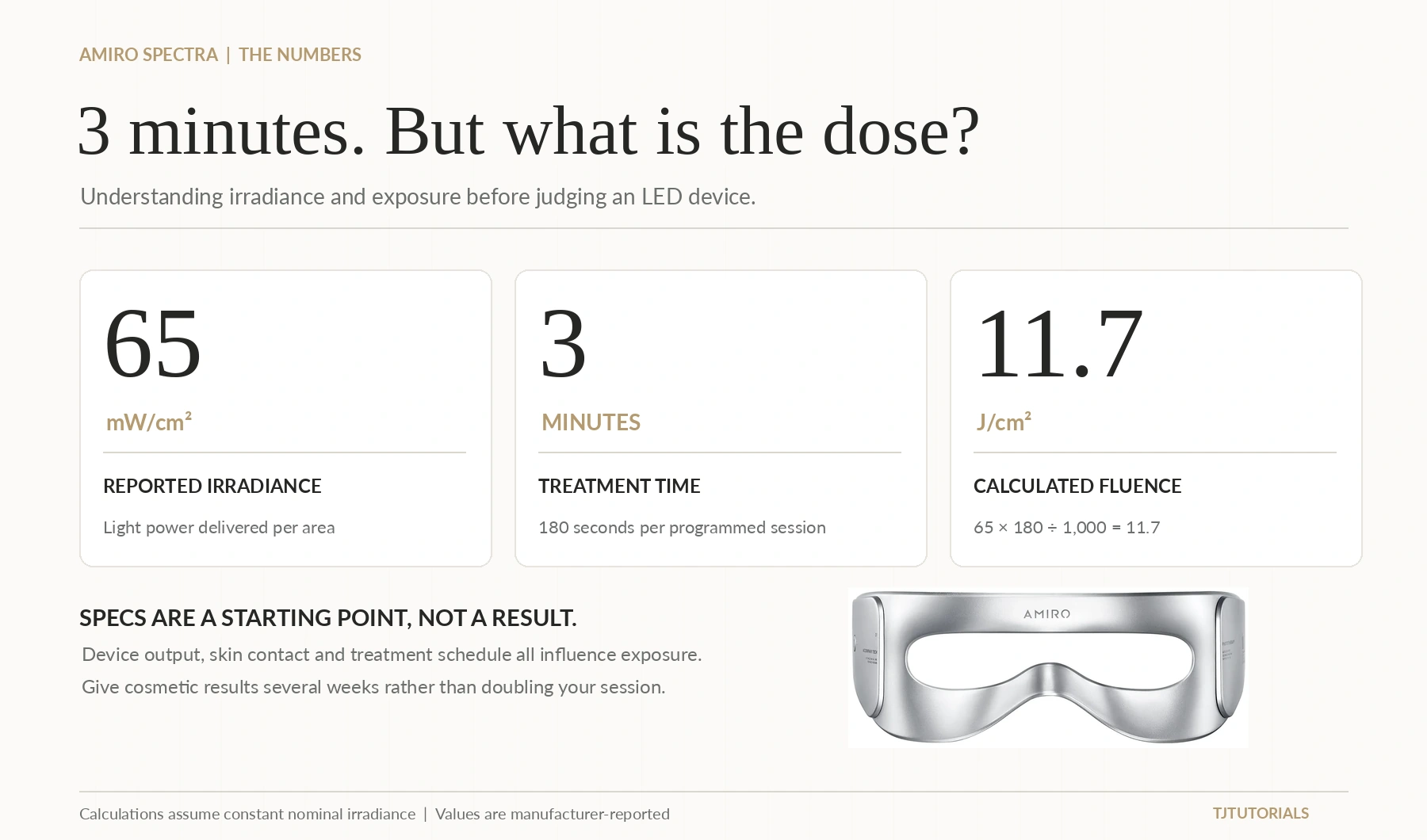
Irradiance describes the light power delivered per unit area, measured in milliwatts per square centimetre (mW/cm²). Fluence, or dose, describes the total energy per unit area, measured in joules per square centimetre (J/cm²).
AMIRO reports 65 mW/cm². For a programmed 3-minute (180-second) session, the nominal calculation is:
65 × 180 ÷ 1,000 = 11.7 J/cm².
That figure assumes the quoted irradiance is maintained throughout the session at the area being measured. It doesn’t independently verify real-world output, how energy is divided across different LED wavelengths, or the dose that reaches each point of your skin.
And longer is not automatically better. Photobiomodulation depends on the relationship between wavelength, power, duration and treatment schedule. I follow the programmed session rather than deciding that if 3 minutes is good, 15 must be spectacular.
I’ve tested enough skincare devices to know that enthusiasm and good judgement aren’t always the same thing.
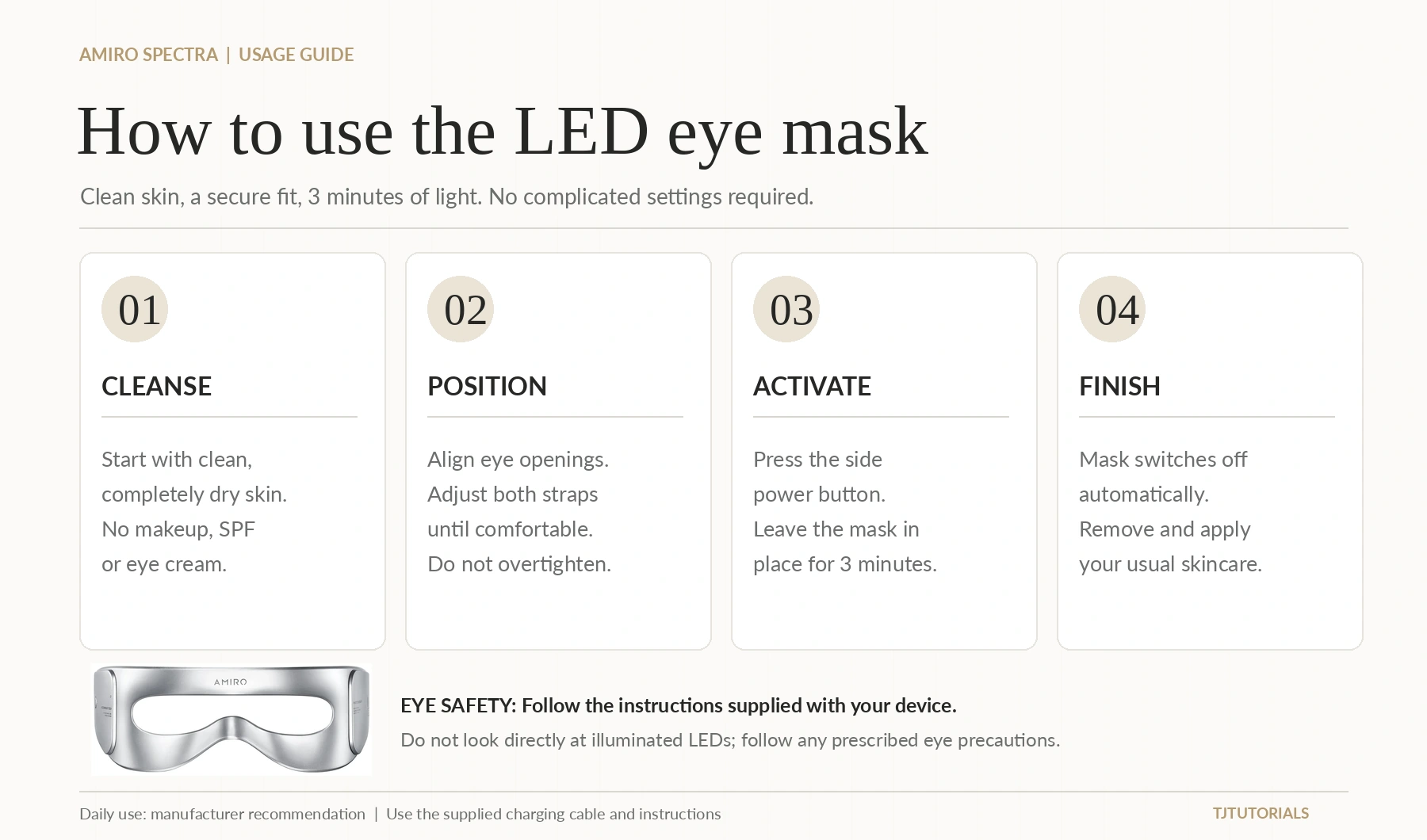
One of the biggest attractions is that there isn’t a complicated routine to remember. This is the treatment order I follow, based on AMIRO’s usage guidance.
Make sure the mask is charged and disconnected from the USB-C cable. Start with clean, completely dry skin, without makeup, SPF, serum or eye cream. AMIRO recommends using the LED treatment before applying skincare.
Place the device around your eye area with the openings correctly aligned. Adjust the straps so the silicone contact area sits comfortably against the skin without pressure or pulling.
Press the side power button. The mask runs its pre-set 3-minute treatment and switches off automatically. There’s no need to move it around your face or select different wavelength programmes.
For eye safety, follow the instructions supplied with your exact device, avoid looking directly into illuminated LEDs, and use any eye protection specified by the manufacturer. AMIRO says the Spectra has undergone IEC 62471 photobiological testing; I would still never turn that into a blanket guarantee of safety for every individual or every way of using it. The American Academy of Dermatology recommends following device-specific eye-protection directions.
Remove the mask once it switches off and follow with your normal topical products. AMIRO recommends daily sessions, but follow the supplied manual and any advice appropriate to your own skin and light sensitivity. If you take photosensitising medication or have a light-sensitive condition, ask an appropriate healthcare professional before using an at-home light device.
I’ve been using the Spectra alongside AMIRO’s Optical Prism Eye Cream system, which adds skincare ingredients and a powered applicator with light, electrical stimulation and massage. I prefer the two as a pairing, but that creates an important limitation when talking about my results.
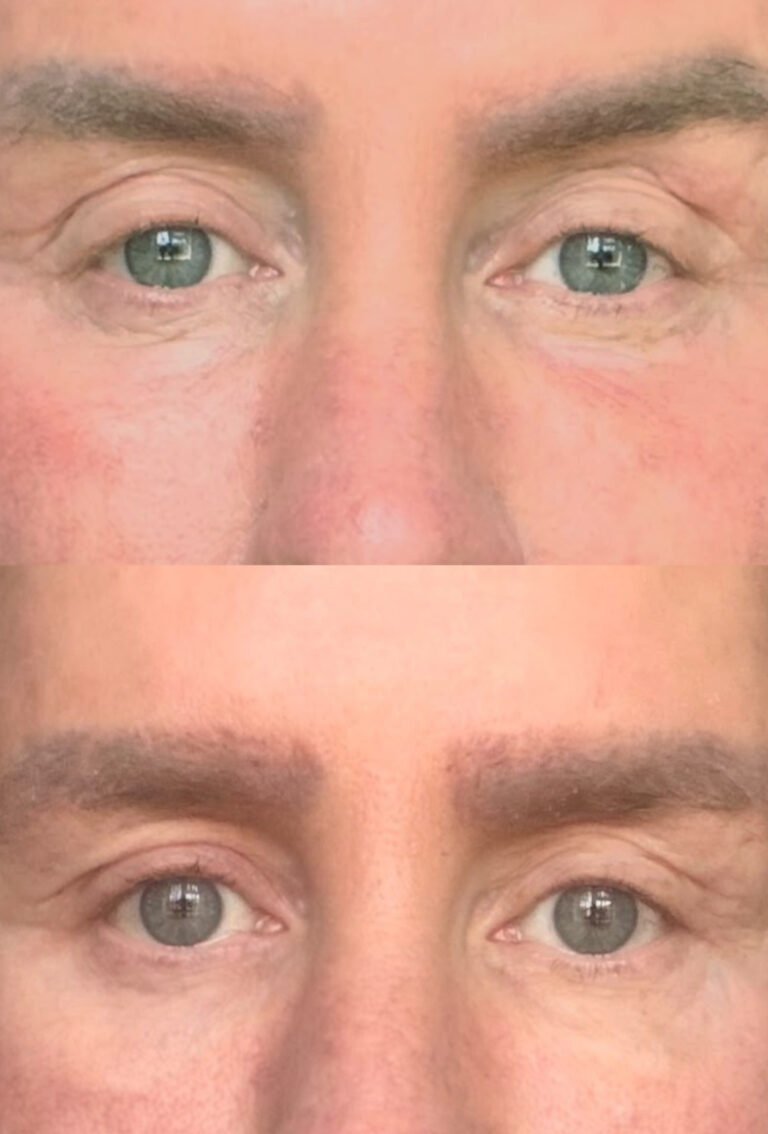
After 8 weeks, I’ve noticed modest improvements in the appearance of under-eye crepeyness, some more prominent lines and the overall eye contour. My under-eye skin also feels a little more supported and looks smoother to me. Nothing dramatic. I’m not about to announce that I’ve somehow acquired a brand-new pair of eyes.
But the area does look more refreshed, and it’s noticeable enough for me to want to keep the routine going. Because I’ve used the LED mask and the EyeGlow system together, I cannot honestly say how much of the difference came from either product on its own.
For me, that distinction is part of a useful review. We can enjoy a product, notice cosmetic improvement and still be clear about what our experience does — and doesn’t — establish.
Potentially with the appearance of some concerns, but I’d approach those claims cautiously. AMIRO’s marketing focuses on brighter-looking under-eyes and improved eye-area appearance. It also publishes customer self-assessment percentages from 30 days of use, which are brand-reported feedback, not the same as an independently published randomised clinical trial.
If your dark circles are heavily influenced by thin-looking skin or uneven skin appearance, a consistent topical and light-therapy routine might complement your overall approach. If the dark appearance is mostly due to tear-trough hollowing and shadows, however, a mask can’t change that anatomy. And while eye-area massage and hydration can influence how refreshed skin looks, I wouldn’t assume a light mask can reliably resolve persistent puffiness from every cause.
A useful starting point is understanding why dark circles can arise from different mechanisms before spending money on a single promised solution.
This is the question I’d ask before buying one.
A good full-face LED mask may already cover much of the region you’re concerned about, depending on its design and eye openings. The Spectra is attractive because the LEDs are arranged for focused eye-area coverage and the session takes only 3 minutes. That convenience might be the difference between a treatment you actually use consistently and another device that spends its life in a drawer.
But I wouldn’t suggest you need a separate mask purely because AMIRO has made one. Have a look at the coverage, wavelengths and usage instructions for the device you already own. If you’re happy with its eye-area coverage, there’s likely some overlap.
AMIRO describes the Spectra as FDA-cleared and says its design has passed IEC 62471 photobiological safety testing. However, I haven’t been able to independently match a specific FDA 510(k) clearance number to this exact retail model using the information displayed on its product page. I’d like that number made easy for shoppers to check.
This isn’t the same as saying the brand’s claim is false. It means I’m distinguishing what AMIRO reports from what I’ve independently verified. The FDA explains that 510(k) clearance concerns substantial equivalence to an existing legally marketed device; it is not proof that a particular mask has been shown in its own clinical trial to improve dark circles or wrinkles by a specific amount.
As with any home device used close to the eyes, the supplied instructions and precautions come first.
I’d put it on the shortlist for somebody new to light therapy whose main cosmetic focus is crow’s feet, under-eye texture and firmer-looking eye skin. The wavelength selection is interesting, the technical specification is more informative than a lot of vague light-therapy marketing, and a 3-minute routine is refreshingly manageable.
I’d be less inclined to recommend it to somebody expecting to eliminate genetic dark circles or replace lost tear-trough volume. And if your existing full-face mask already gives good eye-area coverage, I’d check for overlap before adding another machine to the bathroom.
My verdict: I genuinely like the AMIRO Spectra as a focused, convenient addition to an eye skincare routine. I’ve seen subtle improvements after 8 weeks while using it as part of a paired routine, and the relevant red/NIR research makes the technology worth exploring. Just judge it as a gradual cosmetic tool, not a shortcut to an entirely different eye contour.
You can see the AMIRO Spectra LED Eye Mask and its official specifications here. If you’re purchasing through my content, check the current offer and discount details linked alongside the review. I always recommend comparing the total price and what you already own before deciding.
The four wavelengths are 605 nm amber, 633 nm red, 660 nm deep red and 830 nm near-infrared, as listed in AMIRO’s specifications.
The pre-set session lasts 3 minutes and switches off automatically. AMIRO recommends daily use. Follow the device’s supplied instructions and do not assume that longer sessions give better results.
Think several weeks of consistent use, not an immediate transformation. AMIRO suggests assessing visible cosmetic changes over around 4–8 weeks. Results differ between people and devices. See the AAD’s guidance on using red light therapy for visible signs of skin ageing.
Research on red and near-infrared LED therapy has found improvements in periocular wrinkle appearance in some studies, including a randomised trial of 660 nm red light. These studies used their own devices and protocols, so the findings cannot be treated as guaranteed results for the Spectra.
No eye mask can promise to remove every dark circle. Their appearance may be linked to pigmentation, vascular colouring or the physical shadows created by facial contours. The potential for cosmetic improvement depends on the underlying cause.
After. AMIRO advises starting with clean, dry skin and applying your skincare once the light session has finished.
Research note: This is a personal cosmetic skincare review, not a medical recommendation. Device specifications and consumer feedback are provided by AMIRO unless otherwise stated. The clinical studies linked above examine red/near-infrared light or other LED devices and should not be represented as clinical trials of this exact AMIRO Spectra product. My 8-week observations also reflect a routine using both the Spectra and AMIRO EyeGlow.
Lorem ipsum dolor sit amet, consectetur adipiscing elit. Ut elit tellus, luctus nec ullamcorper mattis, pulvinar dapibus leo.