
Some links in this description are affiliate links. If you use them, I may earn a small commission. No added cost to you, and it helps keep this content going.
Microcurrent devices have become one of the most talked about tools in at home skincare, often marketed as a way to lift, tone, and maintain facial structure over time.
The question most people ask is simple. Do microcurrent devices actually work. The more useful question is different. Why do so many people stop using them. Because the issue is rarely effectiveness. It is adherence.
Most users do not abandon microcurrent because they saw no change. They stop because the routine becomes difficult to maintain. That distinction matters, because results with microcurrent are not based on intensity or one off use. They depend almost entirely on repetition.
How Microcurrent Devices Work on the Skin and Facial Muscles
DermRays Discount Code: TJ140
Microcurrent devices deliver low level electrical currents that interact with both the skin and the underlying facial muscles. These currents are measured in microamps and are designed to support normal neuromuscular signalling. In simple terms, they help reinforce communication between nerves and muscle tissue.
This is not the same as stimulating a muscle contraction in the way exercise does. Instead, microcurrent works by supporting how the muscle functions over time. With repeated use, this can contribute to improved muscle tone, more balanced facial movement, and a subtle lifting effect in areas that tend to lose structure with age.
It is a gradual process, not an immediate transformation.
One of the most misunderstood aspects of microcurrent is how results are achieved. There is no meaningful benefit from occasional use, and there is no advantage in using a device intensively for a short period and then stopping. The effects build slowly through repeated exposure.
This is similar to other long term skincare approaches such as daily sunscreen use or regular retinoid application, where the benefit comes from cumulative input rather than isolated sessions. For most people, this is where the system breaks down. If a device requires too much time, too many steps, or too much concentration, it becomes something that is easy to skip. Once consistency drops, results follow.
Why Many At Home Microcurrent Devices Go Unused
A common issue with at home skincare devices is overcomplication. Many are designed with multiple modes, layered features, and detailed routines that require users to follow specific steps each time they use them. While this can sound appealing, it often creates friction in practice.
Each additional step introduces another point of hesitation. Questions such as which setting to use, how long to use it, or whether it is being used correctly can interrupt the routine entirely. Over time, this leads to reduced use and eventually abandonment. Devices are often not ineffective. They are simply not compatible with everyday behaviour.
What Microcurrent Can and Cannot Do for Ageing Skin
There is also a need to clarify expectations. Microcurrent does not replace structural changes that occur with age. It will not remove excess skin, restore lost volume, or alter bone structure.
What it can do is support the function of facial muscles, which contributes to how the face is held and how it appears at rest. With consistent use, this can lead to improvements in facial balance, a reduction in downward pull, and a more supported appearance in areas such as the jawline and mouth. These effects are subtle and develop gradually over time.
Does Microcurrent Cause Facial Fat Loss
Concerns around facial fat loss are common, but they are not supported by how microcurrent works. Fat reduction requires either a sustained energy deficit or direct disruption of fat cells, and microcurrent operates at levels that do neither.
Changes that are sometimes perceived as fat loss are more accurately explained by fluid shifts or temporary changes in muscle activity. These are not permanent reductions in fat volume and should not be interpreted as such.
Why Higher Intensity Microcurrent Is Not Necessarily Better
Another misconception is that stronger sensation leads to better results. Devices that produce more noticeable tingling can create the impression of greater effectiveness, but sensation is not a reliable indicator of outcome.
Higher intensity can increase the risk of irritation or discomfort, which often reduces the likelihood of consistent use. For ageing skin in particular, regular and moderate stimulation tends to be more beneficial than occasional high intensity sessions. The goal is repeatability, not intensity.
[IMAGE PLACEMENT: device in use in a relaxed, everyday setting]
What Makes a Microcurrent Device Effective in Real Life
Effectiveness in practice is determined less by technical specifications and more by usability. Devices that simplify the process tend to perform better over time because they are easier to integrate into daily routines.
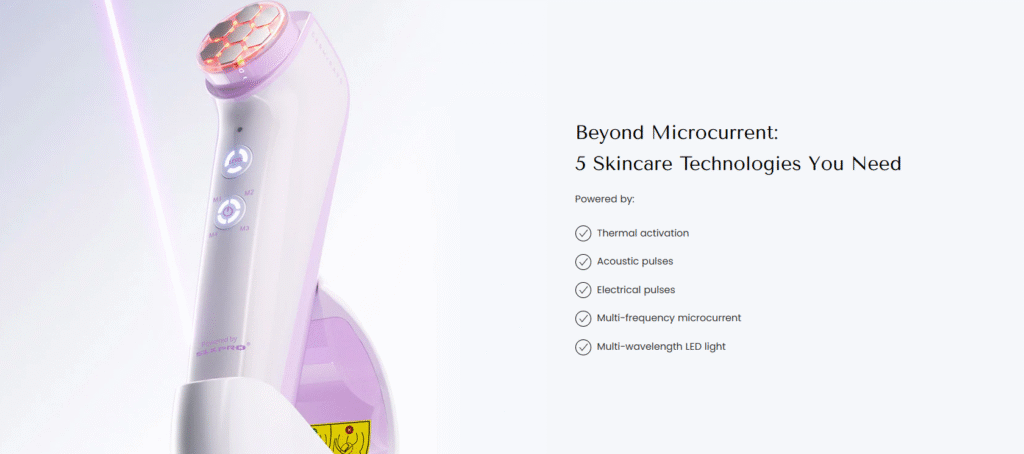
Combining multiple steps into a single, streamlined treatment reduces decision making and lowers the barrier to regular use. This increases the likelihood of consistent application, which is the primary driver of results.
Who Should Use a Microcurrent Device
Microcurrent is best suited to individuals looking for gradual, long term improvement rather than immediate transformation. It is particularly useful for maintaining muscle tone, supporting circulation, and preserving overall facial balance as part of a broader skincare approach.
It is also well suited to those who have previously struggled to maintain device based routines due to time, complexity, or inconsistency.
The effectiveness of microcurrent is not determined by what a device can do in theory. It is determined by whether it is used often enough to make a difference. In most cases, that comes down to one thing: consistency.